
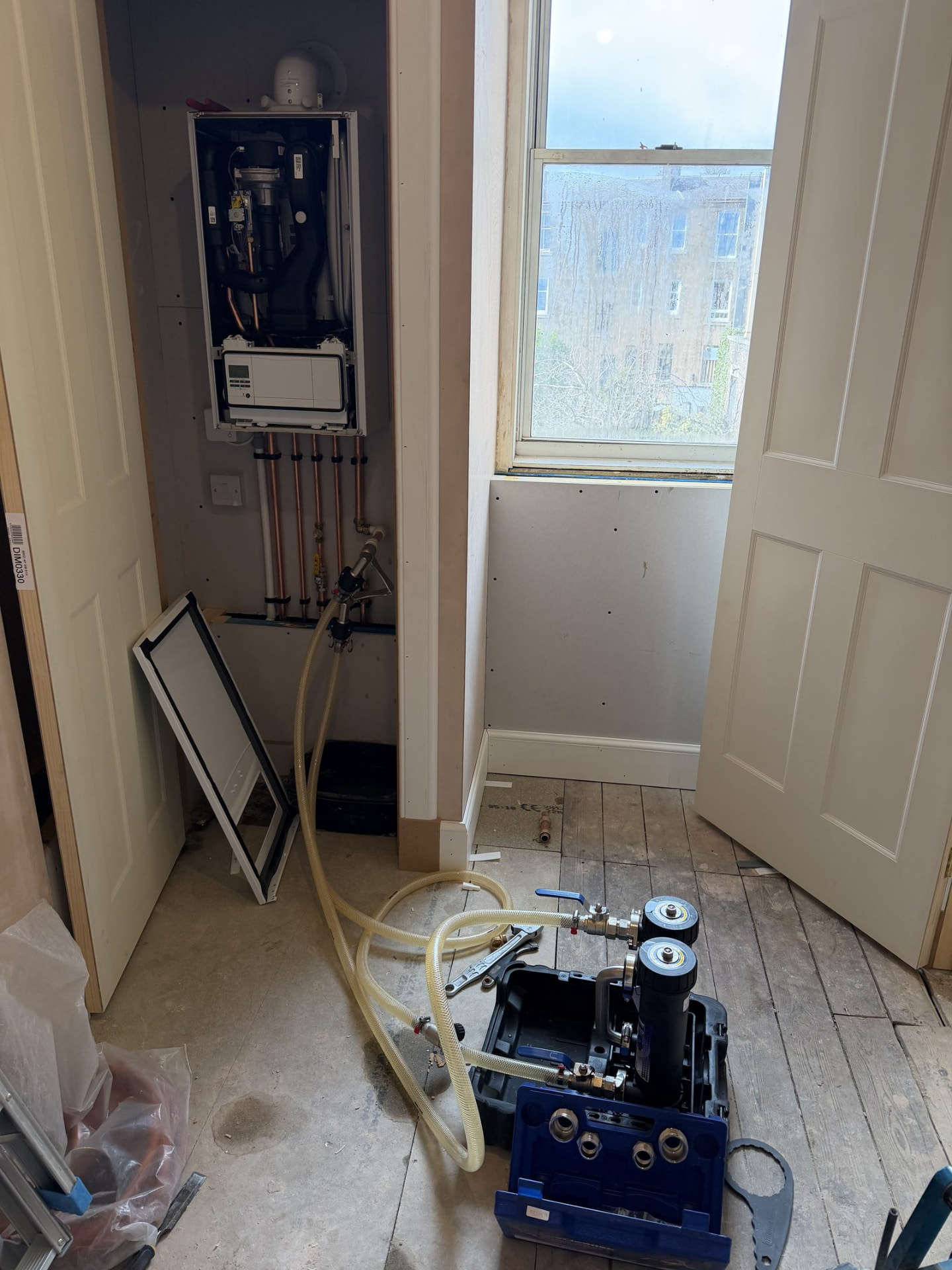
Power flushing · Central heating system cleaning
Power flushingin Edinburgh to clearsludge from your system
Magnetite and debris driven out of radiators and pipework so heat reaches every room, the boiler stops working against a blockage, and your system runs on clean inhibited water, carried out by a Gas Safe registered engineer with a 12-month workmanship guarantee.
20+ years on Edinburgh heating systems · Price agreed before we start
20+ yrs
Working on domestic heating systems
Gas Safe
Registered engineer carrying out the work
12 months
Workmanship guarantee
£2m
Public liability insurance
Domestic
Houses and flats only
The service
Clean water,warm radiators
What it covers
A power flush is a forced circulation clean of a central heating system. A pump is connected to the circuit and, with chemical cleanser and agitation, drives magnetite sludge, corrosion debris and scale out of radiators, pipework and the boiler's heat exchanger, then the system is flushed clean, refilled with fresh water and dosed with corrosion inhibitor. A magnetic filter is normally fitted at the same time to catch what forms afterwards.
Who it's for
For Edinburgh homes with radiators cold at the bottom, rooms that never warm up, a boiler that kettles or bangs, a magnetic filter that fills quickly, or a system that has been drained and refilled repeatedly over the years without inhibitor being replaced. It is also strongly advisable before a new boiler goes onto an older system.
When you need it
Symptoms first: cold spots at the base of radiators, dirty black water when bleeding, noise from the boiler or pump, some radiators warm while others stay cold, frequent bleeding, or a heating circuit that is slow to come up to temperature. Preventatively, before a boiler replacement, and after any period where the system ran without inhibitor.
Why it needs doing properly
System water attacks the metals inside a heating circuit unless it is inhibited. The reaction produces magnetite: a heavy black iron oxide sludge that settles in radiator bottoms, coats internal surfaces and eventually restricts the boiler's heat exchanger. Every millimetre of that deposit reduces heat transfer, so you burn more gas for less warmth, and the abrasive particles wear out pump bearings and valves. A power flush removes it; adding inhibitor and a filter stops it coming straight back.
Leave it and it grows
What sludge doesif you leave it
Sludge does not stabilise. It accumulates, and it damages the most expensive components in the system while doing it.
What it costs if ignored
- Restricted heat exchangers cause kettling and overheating, which is one of the most expensive failures a boiler can have.
- Abrasive magnetite wears out pump bearings and jams motorised valves.
- Radiators blocked from the bottom lose a large share of their output, so rooms never reach temperature.
- The boiler runs longer for the same result, which is a continuous charge on every gas bill through a Scottish winter.
- Installing a new boiler onto a contaminated system can invalidate the manufacturer guarantee and block the new heat exchanger quickly.
- Corrosion eventually perforates radiators from the inside, which is when sludge becomes a leak on your floor.
Common mistakes we're called out to
- Repeatedly bleeding radiators that are cold at the bottom, bleeding removes air, and sludge is not air.
- Draining and refilling a system without re-dosing inhibitor, which restarts corrosion immediately.
- Topping the pressure up week after week, diluting whatever inhibitor is left.
- Fitting a new boiler onto an old dirty system to save the cost of a flush.
- Fitting a magnetic filter to a system that is already loaded and expecting it to clean out what is already in the radiators.
- Assuming a cheap chemical clean alone will shift settled magnetite, it will not without forced circulation.
Our process
How the job runs,step by step
Step 1
Inspection
We assess whether a power flush is actually the right answer: checking radiator temperature profiles, filter condition, water condition and system type. Sometimes the fault is a valve or balancing issue and a flush would be money wasted.
Step 2
Diagnosis and agreed price
You are told what we found, what the flush will and will not fix, and the price before we start. If the system needs a different intervention, you hear that instead.
Step 3
Preparation and connection
The flushing pump is connected to the circuit, the property is protected, and the boiler and system are set up for controlled circulation.
Step 4
Chemical clean and flush
Cleanser circulated through the whole system with flow reversal, and each radiator individually agitated and flushed so the settled sludge in the base actually moves rather than being circulated around it.
Step 5
Testing and verification
The system is flushed through until the water runs clear, refilled, dosed with corrosion inhibitor, vented and balanced, then run under load with every radiator checked top and bottom.
Step 6
Completion and protection
A magnetic filter fitted where there is not already one, the area cleaned, and the work covered by our 12-month workmanship guarantee.
What you get out of it
Specific outcomes,not vague promises
Radiators hot top to bottom
Clearing the settled magnetite restores emitter output that was physically blocked.
Faster warm-up
Clean surfaces transfer heat properly, so the house reaches temperature sooner and the boiler cycles less.
Lower gas use
You stop paying to heat sludge and to run the boiler longer for the same room temperature.
Boiler protected
A clean, inhibited circuit is the single biggest factor in how long a heat exchanger lasts.
Quieter operation
Kettling and banging caused by restricted flow and overheating usually stop once the restriction is gone.
Guarantee-safe for new boilers
Flushing before an installation protects both the new appliance and the manufacturer cover on it.
In detail
Method, chemicalsand when it applies
Power flushing is a method, not a magic fix. Knowing when it is the right method, and when it is not, is the difference between a system transformed and money spent for nothing.
How the method works
A high-flow, low-pressure pump is connected into the circuit and pushes water through at a much greater velocity than the system's own pump can achieve, with the flow direction reversed periodically to dislodge deposits from both ends of each run. Radiators are isolated and agitated individually so the heavy sludge sitting in the base is lifted into suspension rather than left behind while clean water flows over the top of it.
Chemicals used
A cleanser is circulated to break down magnetite and, where scale is present, a descaler. Once the system runs clear it is neutralised as required, flushed with fresh water, and dosed with a corrosion inhibitor sized to the system volume. The inhibitor is the part that determines whether you need this again in five years or twenty.
System types and limitations
Sealed and open-vented systems both flush, but the connection method and the drain-down sequence differ. Microbore systems and very old, heavily corroded pipework need a careful assessment first; a flush can occasionally reveal an existing weakness where corrosion has already thinned a radiator or joint, and it is more honest to raise that possibility beforehand than after.
Power flush versus chemical clean
A chemical clean circulates cleanser using the system's own pump and suits relatively clean systems or a pre-installation tidy-up. It cannot move settled sludge from radiator bases. A power flush uses external forced circulation and individual radiator agitation, which is what actually removes accumulated magnetite. We recommend whichever is genuinely appropriate rather than defaulting to the larger job.
Magnetic filtration and aftercare
A magnetic filter on the return catches magnetite as it forms and is emptied at each annual service. Filter plus correctly dosed inhibitor is the maintenance regime that keeps a flushed system clean. Checking inhibitor levels annually, and re-dosing after any drain-down, is what stops the cycle restarting.
Signs you need one
Radiators cold at the bottom or cold at one end, black water when bleeding, boiler kettling or banging, pump noise, slow warm-up, a filter that fills between services, and repeated component failures. Also as a preparatory step before a new boiler on any system with age and no treatment history.
Questions
Power Flushingquestions, answered
Anything we haven't covered, ask us directly on 07788 373160.
How much does a power flush cost in Edinburgh?
It depends mainly on the number of radiators and the condition of the system, so we assess first and give you the price before starting. If the assessment shows a flush is not what your system needs, we will tell you that rather than sell you one.
How long does a power flush take?
Most domestic systems take the best part of a day. Larger properties with many radiators, or systems that are heavily contaminated, can take longer; you will get a realistic expectation before we begin, not at teatime.
How do I know if my system needs flushing?
The classic signs are radiators cold at the bottom while hot at the top, black water when you bleed, boiler kettling or banging, rooms that never warm up, and a magnetic filter that fills between services. Cold at the top only is usually just air and needs bleeding, not flushing.
Will a power flush fix cold radiators?
It fixes cold radiators caused by sludge, which is the most common cause of a radiator that is cold at the bottom. Cold radiators caused by a seized valve, an unbalanced circuit or a failed pump need a different repair, which is exactly why we diagnose before quoting.
Do I need a power flush before a new boiler?
Not always. A chemical cleanse and a magnetic filter are enough on a reasonably clean system. On an older system with visible contamination, flushing protects both the new heat exchanger and your manufacturer guarantee, and we will tell you which category yours is in at survey.
Can power flushing damage my heating system?
On a sound system, no. On very old or heavily corroded pipework it can occasionally expose an existing weakness where corrosion has already thinned a radiator or joint. We assess the system's condition first and discuss that risk with you honestly before starting.
How often should a system be power flushed?
A system that is properly inhibited and filtered should not need frequent flushing, many go well over a decade. Systems that are repeatedly drained without re-dosing inhibitor, or that have never been treated, need it far sooner.
Will it reduce my heating bills?
It removes the restriction that is making your boiler run longer for the same room temperature, and restores radiator output that was physically blocked. The size of the saving depends on how contaminated the system was to begin with.
Is the work guaranteed?
Yes, 12 months on our workmanship. We also fit a magnetic filter where there is not one already, because a flush without ongoing protection is a temporary result.
Which areas do you cover?
Edinburgh and the Lothians, including Leith, Musselburgh, Dalkeith, Corstorphine, Currie, South Queensferry, Bonnyrigg and Loanhead.
Clear the sludgeand get the heat back
Assessed first, priced before we start, inhibitor and a magnetic filter fitted afterwards. 12-month workmanship guarantee, Gas Safe registered.
Gas Safe registered · £2m public liability · 12-month workmanship guarantee
Related services
Heating
Radiators, valves, pumps and controls put right so every room in the house actually gets warm.
Heating Systems
Full system design, installation and power flushing for older, tired or underperforming systems.
Boiler Servicing
An annual service that protects your warranty and catches faults before they become breakdowns.
See all services, browse the areas we cover, head back to the homepage, or get in touch.
Next step
Request your estimatefrom Pentaburgh
Send the details and we'll come back to you with the next step. If it's urgent, calling is always fastest.
07788 373160